
The India–EU Free Trade Agreement, signed in January 2026, removes or reduces import taxes on over 90% of goods traded between India and the European Union. It is expected to boost Indian exports, create jobs in textiles and manufacturing, lower prices of European luxury goods and medical equipment in India, and make it easier for Indian professionals to work in Europe — making it India’s largest trade deal ever.
Table of Contents
What the “Mother of All Deals” Really Means for Indians, Europeans, and You
On January 27, 2026, India and the European Union (EU) signed one of the biggest trade agreements in modern economic history — the India–EU Free Trade Agreement (FTA).
It is already being called the “Mother of All Deals.” Not because it sounds fancy — but because of its sheer size, impact, and long-term consequences.
This single agreement connects:
- India (1.45 billion people)
- 27 EU countries (450+ million people)
Together, this creates a 2 billion–people market that controls nearly one-third of global trade.
But what does this actually mean in real life?
Will European cars and whisky get cheaper in India?
Will Indian exports explode in Europe?
Will this create jobs or kill local industries?
And most importantly — how does this affect you personally?
Let’s break it down, slowly and clearly.
First Things First: What Is a Free Trade Agreement (FTA)?
A Free Trade Agreement (FTA) is a deal between countries where they agree to:
- Reduce or remove import duties (taxes)
- Make it easier to sell goods and services
- Set common rules for investment, professionals, and intellectual property
Why does this matter?
Because import taxes are expensive.
If India puts a 100% tax on a car:
- A ₹20 lakh car becomes ₹40 lakh overnight
FTAs slowly remove these taxes — making products cheaper, more competitive, and more accessible.
👉 You can internally link here to a general explainer like:
“What Is Import Duty and Why Is It So High in India?”
Why Did India and the EU Take 19 Years to Agree?
Negotiations started in 2007.
They failed multiple times because:
- India wanted job protection
- EU wanted market access
- Farmers, automakers, and alcohol industries were nervous on both sides
- Issues around data privacy, climate rules, and visas
What changed now?
Three Big Reasons
- China risk — both India and EU want alternatives
- Supply chain shock after COVID & Ukraine war
- India’s stronger negotiating position in 2025–26
After 19 years, both sides realized:
Not signing the deal is now riskier than signing it.
What Exactly Is in the India–EU FTA?
This is not just about buying and selling goods.
It covers:
- Goods trade (cars, textiles, medicines, food)
- Services (IT, finance, consulting)
- Professional mobility (visas, work permits)
- Investments
- Technology & clean energy
- Geographical Indications (GI tags)
- Healthcare & medical devices
Think of it as a full-stack economic relationship, not a simple trade pact.
How India Benefits (This Is the Big One)
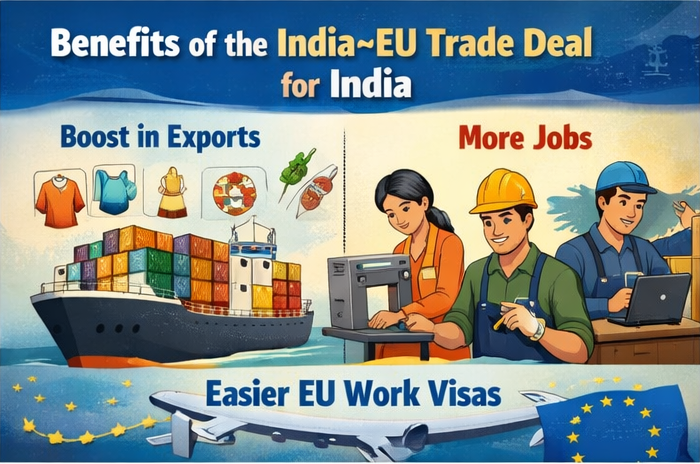
1. Massive Export Boost 🚢
The EU has agreed to remove tariffs on over 90% of Indian goods over time.
This is huge for labor-intensive sectors like:
- Textiles & apparel
- Leather goods
- Gems & jewellery
- Seafood
- Engineering goods
Many of these items currently face 8%–14% taxes in Europe.
Those will go close to zero.
👉 This directly means:
- More exports
- More factory demand
- More jobs in India
(Internal backlink idea: “Why Textile Exports Matter More Than IT Jobs in India”)
2. More Jobs, Especially for Blue-Collar & MSMEs
Unlike tech-only growth, this deal helps:
- Small factories
- Export MSMEs
- Tier-2 & Tier-3 city workers
Sectors like garments and leather employ millions, not thousands.
This is one of the most employment-positive FTAs India has ever signed.
3. Easier Movement for Indian Professionals 🇮🇳➡️🇪🇺
This part is often ignored — but it’s critical.
The agreement includes a professional mobility framework:
- Easier short-term work visas
- Recognition of qualifications
- Better entry for IT, engineering, healthcare, and students
This doesn’t mean open borders — but it removes friction.
👉 External backlink suggestion:
EU Blue Card official site
India Ministry of Commerce FTA page
How Europe Benefits (And Why They Agreed)
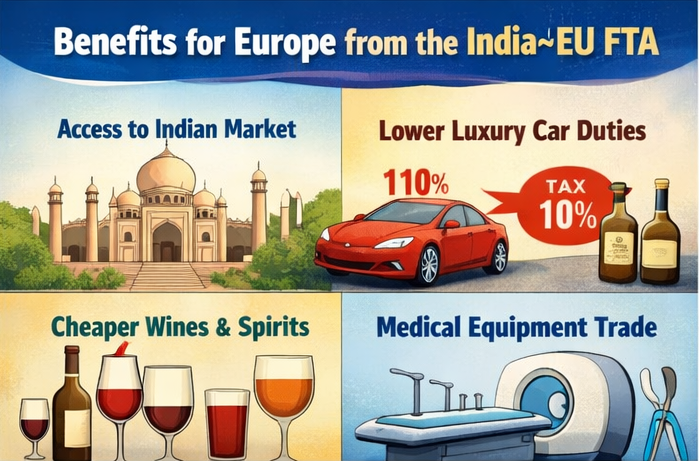
1. Access to India’s 1.45 Billion Consumer Market
India is one of the fastest-growing consumption markets in the world.
The EU gains better access for:
- Luxury cars
- Wines & spirits (Scotch, Champagne)
- Chocolates & processed foods
- Medical devices
- High-end machinery
2. Big Cuts in Indian Import Duties
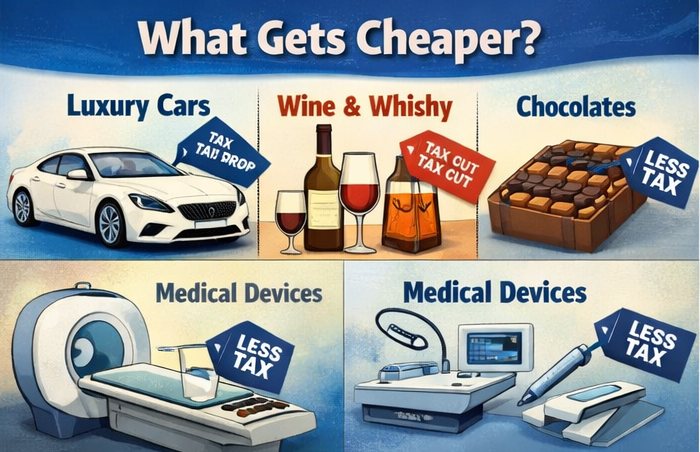
Some eye-opening numbers:
| Product | Earlier Duty | After FTA (Gradual) |
|---|---|---|
| Luxury cars | 110% | Down to 10% |
| Wines & spirits | Up to 150% | Deeply reduced |
| Medical devices | High | 90% removed |
| Chocolates | High | Lowered |
This is why European companies pushed hard for this deal.
What India Protected (Very Important)
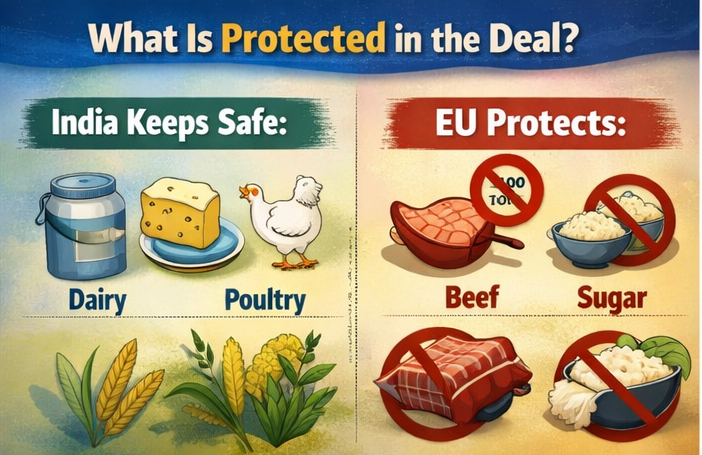
India did not open everything.
Sensitive sectors are protected:
- Dairy
- Poultry
- Certain crops
Cheap European milk or cheese will NOT flood India.
Similarly, the EU protected:
- Beef
- Sugar
- Rice
This deal is selective, not reckless.
What This Means for You (Real Life Impact)
If You Are a Consumer
- European cars, perfumes, chocolates, alcohol get cheaper (gradually)
- Better quality imported goods at lower prices
If You Are a Professional
- Easier EU work opportunities
- Better recognition of skills
- More foreign projects
If You Run a Business
- Indian exports become price-competitive
- Europe becomes a realistic market, not just the US
If You Are a Patient
- Cheaper medical equipment
- Lower hospital costs over time
- Better diagnostics access
(Internal backlink idea: “Why MRI Scans Are So Expensive in India”)
10 Clear FAQs (Plain Answers)
1. Will European whisky and wine become cheaper?
Yes. Import duties are being slashed significantly. Prices will drop over a few years, not overnight.
2. Will German luxury cars become affordable?
They’ll become less absurdly expensive, not cheap. Taxes fall from 110% to as low as 10% over time.
3. Does this create jobs in India?
Yes — especially in textiles, jewellery, leather, and MSMEs.
4. Is it easier for Indian IT professionals to work in Europe?
Yes. Mobility rules are clearer and smoother now.
5. Will healthcare become cheaper?
Likely. Medical equipment imports get tax relief.
6. Are farmers at risk?
No. Dairy and poultry are protected.
7. What is a Geographical Indication (GI)?
It protects product names like Darjeeling Tea or Champagne from fake copies.
8. When does the deal actually start?
After legal review, translations, and ratification by all EU states.
9. What about electric vehicles?
EV import duty cuts are delayed for 5 years to protect Indian industry.
10. Why “Mother of All Deals”?
It’s India’s largest and most comprehensive trade agreement ever.
Common Myths (And the Truth)
Myth: Everything becomes cheap instantly
Reality: Cuts are gradual and phased
Myth: Indian farmers are finished
Reality: Sensitive sectors are excluded
Myth: This is only about trade
Reality: It includes technology, defense, clean energy, and security
Long-Term Strategic Impact (The Bigger Picture)
This deal:
- Reduces India’s dependence on China
- Positions India as a manufacturing alternative
- Deepens India–EU strategic alignment
- Strengthens India’s global negotiating power
This is not just an economic deal.
It’s a geopolitical reset.
Final Editorial Note
This deal won’t change your life tomorrow morning.
But over the next 5–10 years, it will quietly reshape:
- What you buy
- Where you work
- What India exports
- How India is seen globally
And that’s exactly how big economic shifts work — slow, structural, irreversible.